

“Tech-Colonialism: Gentrification, Resistance and Belonging in San Francisco’s Colonial Present” Anthropological Quarterly 95(4): 785-814.
The housing crisis in San Francisco, California, has been marked by unaffordability, displacement, and what activists have called an “eviction epidemic.”
This crisis, in turn, has prompted a wide range of protests in which activists connect the impacts of the technology industry to the region’s unaffordability and gentrification. In this article, I look at the different ways that those contesting gentrification in San Francisco invoke colonialism to understand and contest processes of gentrification. I argue that the critique of gentrification as colonialism provides an important political framework for everyday practices of resistance in the city, in which residents connect their current struggles to longer histories of racialized dispossession. Through a historical section on the history of colonialism in the San Francisco Bay Area I connect these longer histories of racialized dispossession with current struggles over belong and urban space. Furthermore the article offers a framework for understanding the contemporary connections between urban struggles, colonial histories and the tech industry through the concept of what I am calling “tech-colonialism.” Tech-colonialism is understood to be a modality of the colonial present that makes visible the ways in which historical dimensions of gentrification are connected to spatial strategies of the technology industry that are enacted in urban space in San Francisco. What is interesting here is how through looking at different forms of resistance to these processes the connections between longer histories of racialized capitalism and its contemporary manifestations are made clear.

“Infrastructural Activism: Google Bus Blockades, Affective Politics and Environmental Gentrification in San Francisco” Antipode: A Radical Journal of Geography. (2023) 55: 1454-1478 https://doi.org/10.1111/anti.12744
Between 2013 and 2018, the San Francisco Bay Area saw the rise of “Google bus blockades”
—a form of protest against gentrification, growing inequality and a housing crisis linked to the economic impacts of the technology sector on the region. Based on two years of ethnographic fieldwork with housing activists in the San Francisco Bay Area, this article argues that the disruptive tactic of “the Google Bus blockade” can be understood as a form of infrastructural activism—a flexible political form that uses the interruption of infrastructure for political ends. The blockades politicised the “Google buses” and transformed them into symbols of gentrification and sites of resistance. Protestors constructed a political analysis that drew connections between struggles for housing, racial and environmental justice and brought together material, affective and political critiques of infrastructure.
“Reflections on Doing the Work: City Life/Vida Urban and the Anti-Eviction Mapping Project” Manissa Maharawal & E. McElroy with City Life/Vida Urbana. Radical Housing Journal, Vol 3(1): 267-276.
In this collaborative reflection, members of City Life / Vida Urbana (based in Boston) and the Anti-Eviction Mapping Project (based in the San Francisco Bay Area, Los Angeles, and New York City) describe more about their collectives and approaches to community-based and antiracist research, action, and knowledge production for housing justice in the US.
Counterpoints: A San Francisco Bay Area Atlas of Displacement & Resistance by the Anti-Eviction Mapping Project, PM Press (Co-Editor & Collective Member)
This book brings together cartography, essays, illustrations, poetry, and more in order to depict gentrification and resistance struggles from across the San Francisco Bay Area and act as a roadmap to counter-hegemonic knowledge making and activism. […]
Compiled by the Anti-Eviction Mapping Project, each chapter reflects different frameworks for understanding the Bay Area’s ongoing urban upheaval, including: evictions and root shock, indigenous geographies, health and environmental racism, state violence, transportation and infrastructure, migration and relocation, and speculative futures. By weaving these themes together, Counterpoints expands normative urban-studies framings of gentrification to consider more complex, regional, historically grounded, and entangled horizons for understanding the present. Understanding the tech boom and its effects means looking beyond San Francisco’s borders to consider the region as a socially, economically, and politically interconnected whole and reckoning with the area’s deep history of displacement, going back to its first moments of settler colonialism. Counterpoints combines work from within the project with contributions from community partners, from longtime community members who have been fighting multiple waves of racial dispossession to elementary school youth envisioning decolonial futures. In this way, Counterpoints is a collaborative, co-created atlas aimed at expanding knowledge on displacement and resistance in the Bay Area with, rather than for or about, those most impacted.
“The Anti-Eviction Mapping Project: Counter Cartography and Oral History towards Housing Justice in the Bay Area” Manissa Maharawal & Erin McElroy. Annals of the American Association of Geographers 108 (2): 380-389.
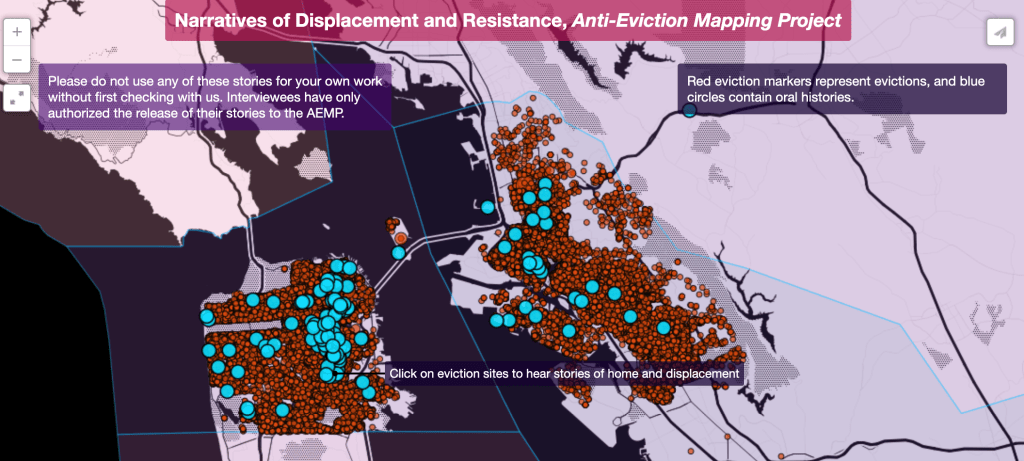
The Anti-Eviction Mapping Project is a data visualization, data analysis, and oral history collective documenting gentrification and resistance in the San Francisco Bay Area. In this article, we discuss the history and methodology of our narrative mapmaking, situating our work in the tradition of critical geography, critical race studies, as well as feminist and decolonial science studies. Aligned with activist work that is fighting for a future beyond the current tech-dominated political economy of speculative real estate and venture capital, our project maps sites of resistance, while remembering spaces lost and struggled for. In this article, we highlight the connections between countermapping, oral history, and housing justice work.
“Occupy Wall Street: Finance Capital and its Discontents.” Manissa Maharawal and Zoltán Glück. Revolting New York: How 400 Years of Riot, Rebellion, Uprising and Revolution Shaped a City. Edited by Neil Smith, Don Mitchell. University of Georgia Press, Athens.
This chapter examines the political geography of Occupy Wall Street in New York City through an analysis of spaces of the movement in lower Manhattan.

“Black Lives Matter, Gentrification and the Security State in the San Francisco Bay Area.” Anthropological Theory 17(3): 338-364.
In the Fall of 2014, Black Lives Matter protests erupted across the United States and the San Francisco Bay Area became the site of nightly demonstrations that deployed a range of disruptive practices and direct actions. The content and style of these protests reflected both the national political issues raised by the Black Lives Matter movement, and highly local and regional struggles over gentrification and displacement. In this article, I analyze these protests in relation to the regional political economy of the tech-industry, the real estate booms, and the attendant ‘eviction epidemic’ in the region. In doing so, I lay out an analysis of the relationship between policing and gentrification in the Black Lives Matter protests in the Bay Area. In the first section, I analyze the regional political economy as the context in which these protests must be understood. In a second section, I argue that the protests created a regional protest geography that, in turn, was met by a regionalized repressive security state. Finally, I read the disruptive practices deployed by these protests as a series of complex and sophisticated contestations which embodied connections among policing, gentrification, and the regional political economy. As such, the Black Lives Matter protests produced an intersectional analysis and can be read as a regional uprising aimed to disrupt the security state.
“San Francisco’s Tech-led Gentrification: Public Space, Protest and the Urban Commons ” in City Unsilenced: Urban Resistance and Public Space in the Age of Shrinking Democracy edited by Jeff Hou and Sabine Knierbein. Routledge, New York.
In this chapter I analyze two struggles over public space: an altercation over a soccer field and the blockade of tech shuttle buses. Through these cases, I analyze how San Francisco residents have contested processes of privatization, enclosure and exclusion in and through struggles over public space. In doing so I argue that such struggles are inherently linked to the colonizing logics of tech-capital and that the forms of resistance it engenders can be understood as a fight for the maintenance of an urban commons.
“In the Time of Trump: Housing, Whiteness, and Abolition” Manissa Maharawal & Erin McElroy. in Abolition Journal, February 4, 2017.
Upon the US electoral victory of real estate mogul Donald Trump, we at the Anti-Eviction Mapping Project (AEMP)–a data visualization, data analysis, and storytelling collective that documents the dispossession and resistance of San Francisco Bay Area residents within contemporary landscapes of gentrification–have been newly theorizing relationships of power, property, race, and displacement.[1] In this piece we think through what it means that a New York City real estate mogul now is President of the United States.

“Occupy Movements: Gender and Sexuality.” The Wiley-Blackwell Encyclopedia of Gender and Sexuality Studies.
Starting in September 2011 the Occupy movement was an international protest movement that focused on issues of social and economic inequality. Local groups had differing foci based on their location and the particular issues that affected them, but a main concern of the movement was that large corporations, the global financial system, and colluding governments all work together in a way that gives a disproportionate amount of power to the few, creates an uneven distribution of wealth and resources, and undermines structures of representative democracy. The movement was characterized through the occupation of (mostly urban) public spaces; in these public spaces participants used direct democracy, assemblies, and consensus decision‐making to live and work together.
“Protest of Gentrification and Eviction Technologies in San Francisco.” Progressive Planning, No. 199. Pgs. 20-24.
On the corner of Market and 8th streets in San Francisco, a group of protesters stepped in front of a private coach bus and unfurled a hand painted blue banner that read, “Eviction Free San Francisco.” It was just after 9:00 am and the bus was picking up employees to shuttle them to Facebook’s headquarters in Menlo Park, about 45 minutes south of the city. A few seconds after the blue banner was unfurled, more protesters appeared with striped orange and white wooden barricades that read, “Warning: Rents and Evictions Up Near Private Shuttle Stops,” and yellow traffic hazard signs that read, “Stop Displacement Now.” They surrounded the sleek, white double-decker luxury bus, preventing it from continuing on its way […]
“Why Public Space Now: A Space for Democratic Practices.” Setha Low, Manissa Maharawal and Dimitris Dalakoglou. Occulus. Pgs. 24-25.
This article, co-authored with Setha Low and Dimitris Dakagolou examines the continued importance of public space in providing political and symbolic spaces of protest, gathering and contestation. It draws on several recent examples of social movements occupying public space as a central form of protest.
“Occupy Wall Street and a Radical Politics of Inclusion.” Sociological Quarterly Vol. 54. Issue 2. Pgs. 177-181.
In this article I argue that there were two distinct tendencies or “logics” of inclusion that operated within the Occupy movement. The first, following Laclau (2005), can be thought of as a populist logic of inclusion that employs a liberal universalist conception of inclusivity in which “the 99 percent” is a taken-for-granted category and understood to exist in itself; the second is what I am calling a radical politics of inclusion enacted through anti-oppressive practices in which ideals of inclusivity are understood as a process and a struggle.
“PUKAR and the Human Right to Research” American Anthropologist 114
(4): 682-693.
The word pukar in Hindi means “to call,” but it is a particular type of calling—it is to call out, or to call for help or attention. PUKAR is also an acronym for Partners for Urban Knowledge, Action, and Research, a charitable trust organization in Mumbai founded in 2006 by Arjun Appadurai and Carol A. Breckenridge. PUKAR is “an independent research collective and an urban knowledge production center” that provides a platform for cross-disciplinary and communitybased research on issues related to urbanization and globalization. In this context, it seems that PUKAR is still “a call out” but a call out for research and knowledge that is produced in places, and by people, whose lives are affected by urbanization and globalization.
“What can we do in Public: Occupy and Challenges in Public Space.” Progressive Planning, Spring 2012. No. 191. Pgs. 20-24.
This article examines the space of Zuccotti Park within the Occupy Wall Street protests and builds out broader reflections on the question of what public space is and how it functions, in both mundane and overtly politically circumstances.

“Reflections on the People of Color Caucus at Occupy Wall Street.” in We are Many: Reflections on Movement Strategy from Occupation to Liberation. Edited by Khatib, Kate, Margaret Killjoy, Mike McGuire eds. AK Press, Oakland. Pgs. 177-183.
This Chapter provides initial and critical reflections on the people of color caucus at Occupy Wall Street. As a co-founder of the caucus, I draw on personal and political experiences to examine the group’s dynamics and lessons from the movements. Drawing on my work as an anthropologist studying activism, I reflect on larger dynamics of organizing around racial justice within broader social movements.

“Standing Up.” in Occupy! Scenes from Occupied America. Edited by Keith Gessen, Sarah Leonard, Nikhil Saval, Astra Taylor et al. Verso, New York. Pgs. 34-40.
This chapter draws on my experiences of organizing during the early stages of Occupy Wall Street. Here I reflect on the deliberation process that went into the drafting of the “Declaration” of Occupy Wall Street and the struggles over including racial justice language into the declaration.
“Occupy Wall Street is Transforming its Participants, Our Country, and Democracy.” in The 99%: How the Occupied Wall Street Movement is Changing America. Hazen Don, Tara Lohan, Lynn Parramore, eds. Alternet, New York. Pgs. 50-55.
***
Public Scholarship
2015 “Shut It Down: Notes on the #blacklivesmatter Protests in Oakland, California.” FocaalBlog February 23
2014 “Making Space to Talk About Race” Brooklyn Historical Society blog. November.
2014 ” Ballot Measure targeting AirBnb headed for November 2015 election (with Tim Redmond and Erin McElroy) on 48 Hills (48hillonline.org) November 25.
2014 “Organizing Against Empire: Struggles Over the Militarization of CUNY.” (with Zoltán Glück, Isabelle Natasia and Conor Tomas-Reed) The Berkeley Journal of Sociology. Vol. 58. Pgs. 51-58.
2013 “Hidden in Plain Sight: The Education Movement” (with Zoltán Glück, Isabelle Nastasia, Conor Tomas Reed) Tidal Magazine:Occupy Theory. February.
2012 “Fieldnotes on Union Square, Anti-Oppression, and Occupy.”Cultural Anthropology, Hotspots online feature (edited by Maple Razsa and Jeffrey Juris). http://www.culanth.org/fieldsights/88-fieldnotes-on-union-square-anti-oppression-and-occupy Feburary 14.
2012 “Why Race Matters After Sandy” (with Isabelle Nastasia) on Waging NonViolence (wagingnonviolence.org), November.
2012 “Occupy Ethnography: Reflections on Studying the Movement.” (with Zoltán Glück) Possible Futures: Dispatches, Social Science Research Council, possible-futures.org, March 14.
2012 How Students are painting Montreal Red (with Zoltán Glück) on Waging NonViolence (wagingnonviolence.org), May, 2012 [Republished in The Indypendent, Alternet, Common Dreams,Tikkun, Occupywallstreet.ent, Clarion]
2012 “Actions and Demonstrations planned to Mark the 1st anniversary of Occupy Wall Street” AlterNet (alternet.org), September 12.
2012 “Occupy Wall Street panel: has May Day made a difference?” (With Tom Hayen, Billy Talen, Rinku Sen, Janter Byrne, Hannah Appel) The Guardian UK, Wednesday May 2.
2012 What Has Occupy Been Up To? 6 Great Actions You Can’t Miss This Spring” in AlterNet (alternet.org), March 13th
2012 Can OWS Take Down Bank of America? Waging NonViolence (wagingnonviolence.org), March 8th 2012 [Republished at Alternet (alternet.com) and Nation of Change (nationofchange.org)]
2012 Why Occupy Wall Street Matters to Me and How it Can Continue to Matter: A Response to Esther Choi, in In Front and Center (infrontandcenter.wordpress.com), January 5th 2012 [Republished in Racialicious (racialicious.com)]
2011 What Makes Occupy Different: Inclusion in The Guardian UK (theguardian.uk) November 15.
2011 So Real it Hurts: Notes on Occupy Wall Street” racialicious.com, October 3. [Republished in The Occupied Wall Street Journal; Left Turn; N+1]
2011 Inside the Student Movement: Undeterred by Crackdown, Activists Around the Country Gear Up for Bigger Actions AlterNet (alternet.org), November 27.
2011 A Day in the Movement (with Zoltán Glück), N+1 Magazine (nplusonemag.com), November 15.
 Manissa Maharawal